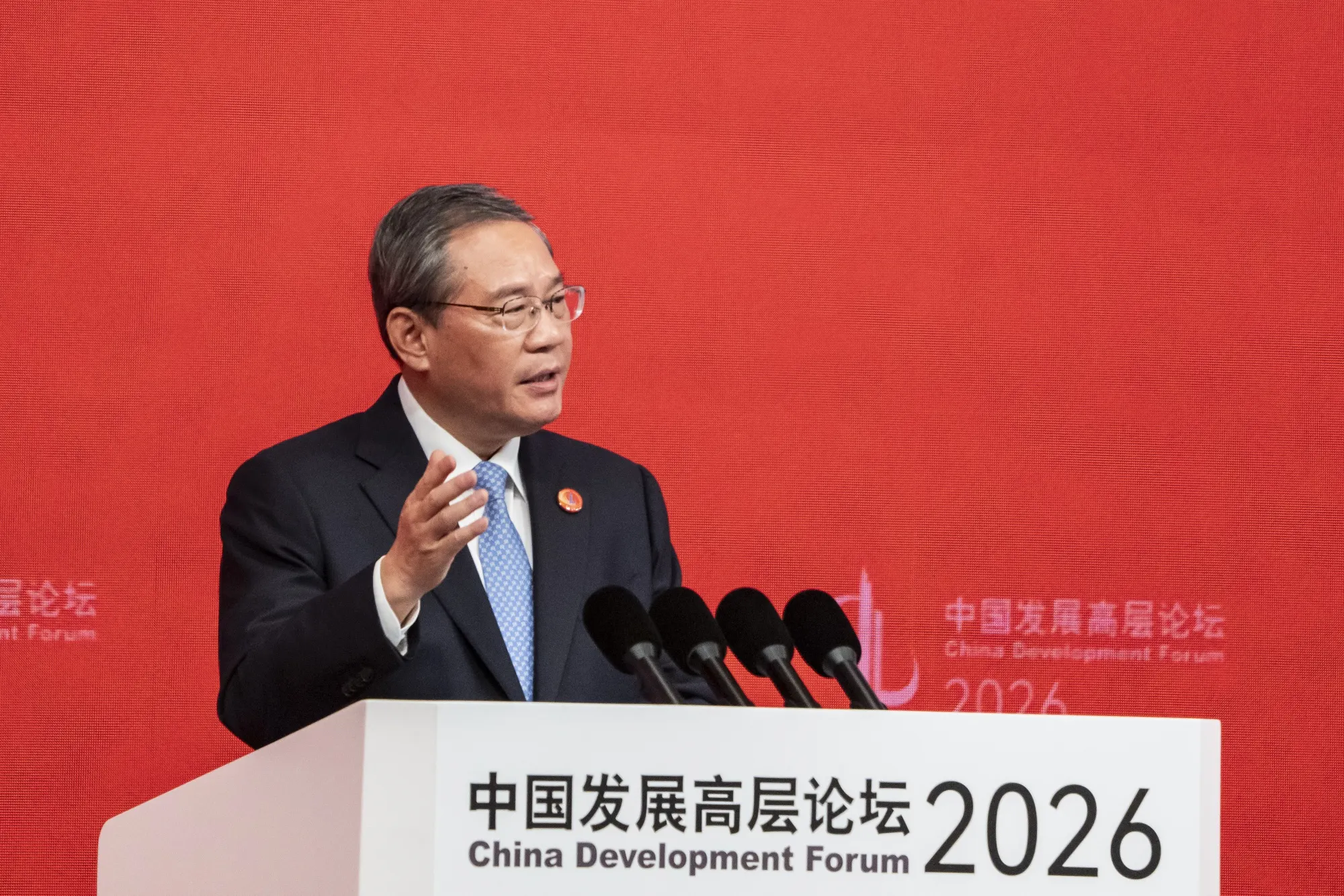
Li Qiang addresses the China Development Forum 2026, outlining Beijing's economic commitments.
Source: Bloomberg News
Beijing is trying to sell two ideas at once: China is still open for business, and China’s giant trade surplus should not be read as a threat. Premier Li Qiang used the China Development Forum to promise more balanced trade and equal treatment for foreign companies after China posted a record $1.2 trillion trade surplus for 2025. That leaves China trying to reassure trading partners and multinational executives at the same moment its export machine is drawing more scrutiny in Washington, Brussels and other capitals.
Li’s message was carefully calibrated. He said China would import more high-quality foreign goods, fully implement national treatment for foreign-funded firms and keep opening the economy. Xinhua cast that pitch in broader ideological terms, with Li arguing that protectionism is no panacea and that China’s industrial strengths come from competition and innovation rather than subsidies or protection. Beijing is also trying to stop the surplus debate from collapsing into a simple goods story: central bank governor Pan Gongsheng said China runs the world’s largest goods surplus but also its largest services deficit, according to Reuters.
The pressure point is not just trade diplomacy. China is also trying to arrest a slide in foreign investment, with foreign direct investment down 5.7 percent in January after a 9.5 percent drop in 2025. That helps explain why executives from Apple, Samsung, Volkswagen, Broadcom, Siemens and other multinationals showed up in Beijing, and why Chinese officials spent the forum promising fair competition, stronger intellectual-property protection and more policy transparency. For global companies, the offer is continued access to a huge market; the risk is that geopolitical friction and overcapacity complaints keep narrowing the room to operate.
For now, Beijing has a temporary truce with the US on trade, but the clock is running. Bloomberg noted Li’s comments showed concern that the surplus could disrupt relations with more nations, not just the United States. If China cannot convince partners that more exports will be matched by more imports and a fairer competitive field, the next wave of pressure is likely to land on tariffs, market access and supply-chain policy rather than on rhetoric alone.